
Does your company show up in AI answers? Three ways to check for yourself
You can check once without any tools: ask the way a buyer would, try a few phrasings, and see whom AI cites. How to list your questions, the four things to record, how to read the results, and when to hand it to a tool for regular tracking.
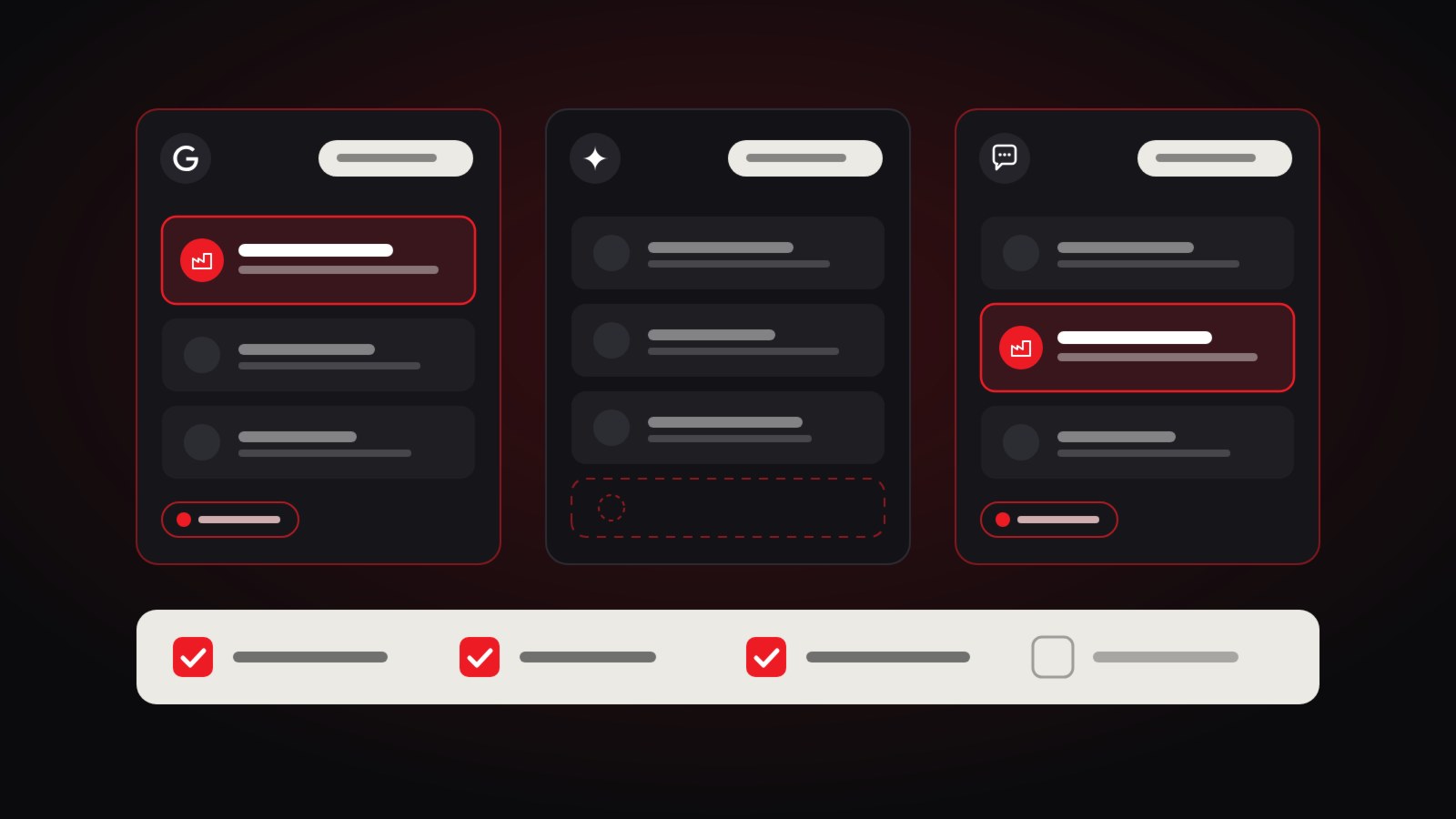
The quickest way to know whether ChatGPT and Gemini recommend your company is to ask them yourself, but ask the way a buyer would. This article covers how to list your questions, what to record, how to read the results, and when to hand it to a tool for regular tracking. It's the first step in What is GEO?
The short version
- Don't ask AI "what does our company do?" Ask the questions buyers ask, without your company name.
- Ask each question once in ChatGPT, Gemini and Google AI Overviews; the three often answer differently.
- Record four things per question: are you mentioned, in what position, how are you described, which pages are cited.
- AI answers change every time, so one result is only a reference; regular tracking is what shows the trend.
Ask as a buyer, not by your own name
The most common mistake is to ask AI "what does Company X do?" That only tells you whether AI knows you, not whether it thinks of you when a buyer is looking for a supplier.
Ask the questions buyers ask, and leave your company name out. List 10 to 20, in three groups:
- Finding suppliers: "Which factories in Taiwan do precision stamping?" "Which suppliers do you recommend for automotive fasteners?"
- Comparing and choosing: "What kind of shop should I look for for small-batch custom injection moulding?" "How do I choose between stainless and carbon steel fasteners?"
- Solving problems: "Quotes from drawings always take a week. Is there a faster way?"
The third group is often skipped, but it's closest to a buyer's real situation, and the most likely to bring up suppliers who know the trade.
Three methods
Method one: ask the same question in three places
Ask ChatGPT and Gemini once each, then search the same sentence on Google and look at the AI Overview at the top. The three read different sources and often give different answers.
Google's AI Overviews don't appear on every search. In Pew Research Center's 2025 tracking, about 18% of Google searches showed an AI summary, and the longer and more sentence-like the query, the more likely one appeared. So when testing, type the full sentence a buyer would, not just two or three keywords.
Method two: try three phrasings
Phrase the same need differently: by product, by industry, by region. Each change may change the shortlist. If only one phrasing brings you up, AI remembers you only in a very narrow situation.
Method three: see whom it cites
AI answers usually come with source links. Are they competitors' websites, trade media, association directories or price-comparison platforms? Those sources are how AI learns about your industry. If every citation is someone else's site, your website isn't offering content AI can use.
Record four things per question
| What to record | How to look | What it tells you |
|---|---|---|
| Are you mentioned | Is your company name in the answer | Basic visibility |
| Position | Where you rank among the companies listed | How strongly you're recommended |
| How you're described | What it says you do and what sets you apart | Whether AI understands you correctly |
| Which pages are cited | Where the source links point | Which of your pages is doing the work |
The "how you're described" column is the one most often skipped, and it matters. AI sometimes mentions you but gets your products or location wrong. That usually means the information on your website isn't clear enough, or conflicting versions exist online, such as an old address or a discontinued product line.
How to read the results
- Not mentioned at all: check the technical side first, whether AI's crawlers can read your website (see step two of What is GEO?), then add content about who you are and structured data.
- Mentioned, but low down or described wrongly: your content isn't specific enough. Follow What kind of content does AI cite? and write out your specifications, industries and cases clearly.
- Mentioned, but citing someone else's pages: AI knows you through third parties. The good news is it remembers you; next, make your own website the source it cites.
The limits of checking by hand
Checking by hand once or twice is fine, but AI answers change every time. The same question asked today and next week may produce a different shortlist, and with more questions and more AIs, a spreadsheet soon can't keep up.
Echo, which TAITAN built in-house, does exactly this: it regularly puts the questions you set to ChatGPT, Gemini and Google AI Overviews, tracks visibility, share of voice, average position and cited sources, and turns the results into an optimisation plan. How it works is on our SEO/GEO service page.
To see where you're starting from, try the Free Website Check, or book a 360° Diagnosis.
Further reading
- Series overview: What is GEO? How it differs from SEO, and where a B2B company should start
- What kind of content does AI cite? 7 ways to get ChatGPT and Gemini to cite your website
- What is structured data, and why does AI need it to read your website?
References
- Pew Research Center (2025). Google users are less likely to click on links when an AI summary appears in the results.
- Google Search Central. AI features and your website.
- OpenAI. Overview of OpenAI Crawlers.