
What is llms.txt? A site summary written for AI, and whether you need one
llms.txt is a Markdown file at the root of a website that describes the site for AI, proposed in 2024. It costs little to make, but Google has said plainly that it isn't needed and won't help rankings. What it looks like, where things actually stand, and where a B2B website should put its effort.
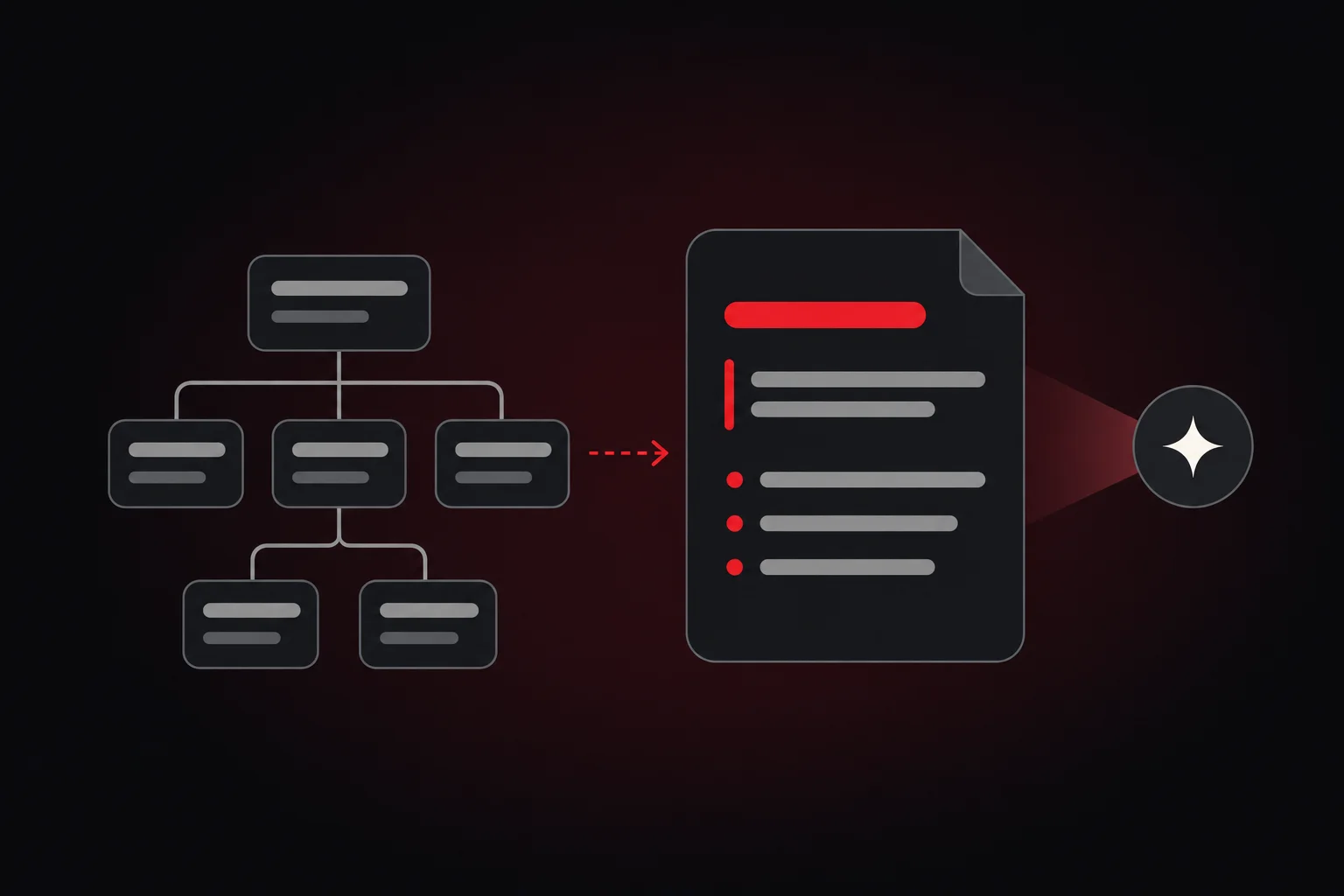
llms.txt is a Markdown text file placed at the root of a website (for example www.example.com/llms.txt) that briefly tells AI who the site belongs to and where the important pages are. It was proposed by Jeremy Howard in September 2024 and is still a proposal, not an official standard. This article belongs to the GEO series.
The short version
- llms.txt has only one required element: an H1 with the name of the site or project. Everything else is optional.
- Google's official documentation says you don't need to create AI text files or special markup to appear in AI Overviews.
- It costs little, so having one is fine, but don't expect it to bring rankings or citations. What actually helps is the content of your pages and your structured data.
What it looks like
According to the proposal at llmstxt.org, an llms.txt contains, in order:
- An H1 heading: the name of the site or project. This is the only required part.
- A blockquote: a one- or two-sentence summary, optional.
- Descriptive text: more background, optional.
- H2 sections: each lists a set of links as
[name](url), optionally followed by a colon and a note. - An Optional section: by convention, secondary links that AI can skip when it needs less context.
An llms.txt for a B2B factory might look like this (an example, not a real company):
# Example Precision Industries

> A CNC precision machining shop in Taichung, Taiwan, making aluminium and stainless steel parts, with orders from one piece.

## Products and processes

- [5-axis machining](https://www.example.com/5-axis/): equipment, working range, tolerances
- [Catalog](https://www.example.com/catalog/): specs page by page

## Company

- [About us](https://www.example.com/about/): founding year, certifications
- [Request a quote](https://www.example.com/contact/): send drawings and quantities
The proposal also suggests offering a clean Markdown version of important pages, so AI doesn't have to parse the full web page.
Where things actually stand
This is the most important thing to know before making one.
Google's AI features and your website is direct: to appear in AI Overviews and AI Mode, "You don't need to create new machine readable files, AI text files, or markup," and there is no special schema.org structured data to add. In other words, Google Search won't look at you more closely because you have an llms.txt.
Google's search advocate John Mueller has also said publicly that he hasn't seen the major AI chatbots fetching llms.txt in server logs; they fetch the pages themselves.
So the honest conclusion: llms.txt is a summary that would be useful if AI read it, but there is currently no evidence that major AI tools rely on it when deciding whether to cite you.
Where a B2B website should put its effort
Ranked by impact, roughly:
- AI crawlers can read you. robots.txt doesn't block Googlebot or OAI-SearchBot.
- Content is text, and specific. Specs, capacity, lead times and certifications are written on the page, not locked in images and PDFs. See What kind of content does AI cite?
- Structured data matches the page. See What is structured data?
- llms.txt. Once the first three are done, add it as one more clear index.
How Ditto does it
On websites built with Ditto, llms.txt is generated automatically along with the sitemap and robots.txt, and updated when pages change, with no upkeep. We put the effort into the first three: making the site readable for AI, specific in content and correct in structured data. To find out what your website lacks in the eyes of AI, book a 360° Diagnosis.
Further reading
- Series overview: What is GEO? How it differs from SEO and where B2B companies should start
- What is structured data, and why does AI need it?
- What kind of content does AI cite? 7 ways to get ChatGPT and Gemini to cite your website
- Ditto series: What is Ditto?
References
- Jeremy Howard. The /llms.txt file.
- Google Search Central. AI features and your website.
- OpenAI. Overview of OpenAI Crawlers.